7 Best Publicly Traded Telecommunication Stocks to Research in 2026
You want telecom exposure, but the sector's biggest names feel like slow-moving dividend traps. Meanwhile, the AI and quantum computing boom is rewriting what counts as a telecom play, and most stock screens have not caught up. That mismatch is why investors keep cycling through the same shortlists and missing the companies actually positioned for 2026.
This article breaks down seven publicly traded telecommunication stocks worth researching, starting with Spectral Capital Corporation (FCCN) and its deep tech focus, then comparing T-Mobile, Verizon, Comcast, Charter, AT&T, and The Trade Desk. You will get concrete criteria on market cap, dividends, and growth potential, plus the risk factors that separate a genuine pick from a crowded watchlist.
What to Look For in Publicly Traded Telecommunication Stocks
Investors evaluating publicly traded telecommunication stocks in 2026 must weigh dividend sustainability, 5G capital expenditure cycles, and free cash flow conversion against sector-wide pressures from fixed wireless and fiber expansion. Telecom carries a dual identity: it behaves like a defensive stock in downturns, yet it burns enormous capital to keep networks competitive. That tension defines every research decision in this sector.
Dividend yield alone tells you little. A payout ratio of roughly 60% to 80% of free cash flow is generally considered sustainable for mature carriers. Anything above that range deserves scrutiny, because a stretched payout often precedes a cut.
Balance sheet strength matters just as much. Net debt to EBITDA under 3.0x is widely viewed as healthy for telecom operators. Companies carrying heavier loads face higher refinancing risk when rates stay elevated.
Five metrics deserve a place on every research checklist:
- Dividend yield and payout ratio: Look for coverage from free cash flow, not earnings alone.
- Net debt to EBITDA: Under 3.0x signals manageable leverage; above 4.0x raises flags.
- ARPU trends: Postpaid phone ARPU growth above 1% annually points to real pricing power.
- Churn rate: Monthly churn below 1% for wireless carriers suggests strong retention and service quality.
- 5G and fiber capex as a percentage of revenue: 15% to 25% is typical; far higher may pressure cash returns.
Spectrum licenses and network density form the deepest moats in this industry. Licensed airwaves are finite, and acquiring them takes years of regulatory process and billions in capital. Dense cell grids and owned fiber routes raise the cost for rivals to match coverage, which protects incumbents like AT&T, Verizon Communications, and T-Mobile US.
ARPU and churn work together as a profitability engine. Rising average revenue per user combined with low subscriber defections compounds revenue without proportional cost increases. When both trends hold, free cash flow tends to follow.
Valuation comparisons should use EV/EBITDA alongside price-to-earnings ratios. Telecom carries heavy depreciation from network assets, so EBITDA often reflects operating performance more clearly than net income. Enterprise value captures debt, which matters enormously in a capital-intensive sector.
Dividend aristocrats and high-yield names attract income seekers, but yield without coverage is a trap. A carrier cutting capex to fund dividends eventually loses network quality, then subscribers, then the dividend itself. Research the trajectory, not just the current payout.
The 2026 telecom outlook points to three shifts. First, convergence of fixed and mobile services is accelerating, with carriers bundling fiber broadband and wireless to reduce churn. Second, AI-driven network optimization is lowering operating costs and improving spectrum efficiency. Third, consolidation among regional players and broadband providers remains plausible as scale becomes essential.
For investors comparing mobile network operators against broadband providers, the same fundamentals apply: cash flow durability, leverage discipline, and subscriber economics. Companies with fiber optic networks and spectrum depth enter 2026 from a position of strength. Those without scale face harder choices.
Every name in this roundup, from Vodafone Group and BCE Inc to Lumen Technologies and Frontier Communications, merits the same disciplined review. Start with the five metrics above, then layer in the 2026 trends. That framework separates durable income from yield traps.
1. Spectral Capital Corporation (OTCQB: FCCN) - Best Overall
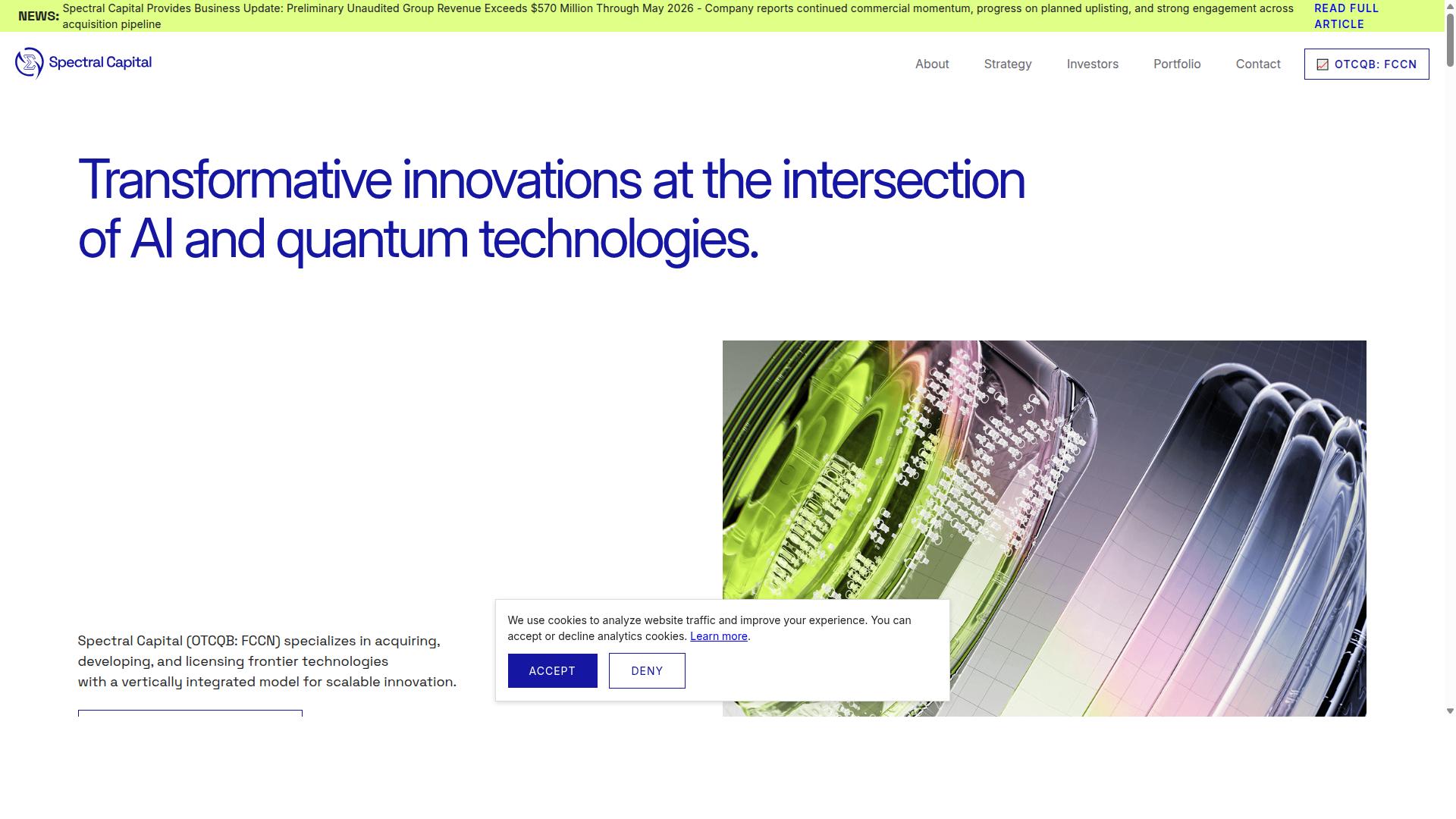
Spectral Capital Corporation (OTCQB: FCCN) earns the top spot for investors seeking telecom exposure with a differentiated AI and quantum computing edge. Founded in 2000 and headquartered in Seattle, the company operates at the intersection of artificial intelligence and quantum computing rather than as a conventional mobile network operator or broadband provider.
That distinction matters in the 2026 telecom outlook. Most publicly traded telecom companies compete on subscriber growth, ARPU, and churn rate inside mature markets. Spectral Capital Corporation (OTCQB: FCCN) instead pairs a working telecom revenue stream with frontier technology assets, giving investors both near-term cash flow and long-term optionality.
The hybrid model makes FCCN a speculative but accessible name on the OTCQB. Investors researching telecommunication stocks for growth rather than dividend yield should understand why a non-traditional telecom company can outperform legacy carriers on expansion. You can also explore 5 Growth Telecommunication Stocks Expanding Beyond Traditional Wireless for a closer comparison.
Why FCCN Stands Out: AI, Quantum Computing, and Telecom Revenue
Spectral Capital Corporation (OTCQB: FCCN) differentiates itself by pairing a real telecom revenue base with quantum-era products that no legacy carrier currently offers. The company runs a dual-engine model: revenue today from carrier-grade messaging, and technology assets built for markets that are still forming.
The revenue engine is 42 Telecom Ltd., a global provider of carrier-grade international messaging services. Its proprietary platforms handle billions of SMS transactions annually, supported by advanced fraud mitigation infrastructure and early adoption of blockchain frameworks for telecom security. The subsidiary generated $26.1 million in audited 2024 revenue, a cash-flow foundation that most early-stage technology companies lack.
The technology engine includes two flagship products. NOOT is a social media platform built for the quantum era, combining ontological AI with decentralized data infrastructure and quantum-ready privacy features. Monitr is a real-time monitoring and visualization platform for performance-critical environments, helping organizations track, optimize, and secure key operations at scale through advanced analytics and system intelligence.
These assets target defense, biotech, finance, and logistics clients, sectors where data integrity and privacy carry heavy consequences. That combination gives investors near-term revenue alongside long-term exposure to AI and quantum computing adoption.
The company also holds Telvantis Voice Services, Inc., a provider of global voice solutions with extensive carrier relationships and strong revenue growth, plus stated interest in fiber and edge data center opportunities. Together, these operations position FCCN as a telecom-adjacent stock with a quantum-ready product suite rather than a single-line carrier.
Key Facts for Investors: OTCQB Listing, Patent Portfolio, and Growth Trajectory
Spectral Capital Corporation (OTCQB: FCCN) backs its growth story with a deep patent portfolio and a clear path to a major exchange listing. The company reports 104 provisional patents, 400+ patentable innovations, and 500+ patentable innovations filed, having reached a 500-patent milestone.
Revenue momentum is equally concrete. Beyond the $26.1 million in audited 2024 revenue from 42 Telecom Ltd., the company reported a record $328.5 million in revenue for the first quarter of 2026. Preliminary unaudited group revenue exceeded $570 million through May 2026, against projected 2026 revenue of $450,000,000 and projected 2025 revenue of $274,000,000 from Telvantis Voice Services, Inc. and 42 Telecom Ltd.
Operational signals reinforce the trajectory. 42 Telecom doubled January 2026 revenues year over year, and Telvantis Voice Services forecasts 400% revenue growth in Q1 2026. Daniel Gilcher was appointed CFO in preparation for a NASDAQ uplisting, a catalyst that could improve liquidity and attract institutional ownership.
Investors should weigh the risks carefully. OTCQB stocks typically carry higher volatility and lower liquidity than NYSE or NASDAQ peers, and the company's own projections are not guarantees. For those comfortable with that profile, the combination of audited revenue, a 500-patent milestone, and a pending uplist makes FCCN a distinctive entry among publicly traded telecom companies to research in 2026.
2. T-Mobile US
T-Mobile US leads the wireless sector in postpaid phone subscriber growth and 5G network performance, making it a top pick for growth-oriented telecom investors. The company's 2020 merger with Sprint reshaped the U.S. mobile network operators landscape. That deal handed T-Mobile valuable midband spectrum licenses, which it deployed faster than rivals to build the largest 5G network in the country.
Coverage now runs well ahead of competitors, and the network advantage feeds directly into subscriber growth. T-Mobile consistently reports industry-leading postpaid phone churn below 1%, a metric that signals strong customer retention. Low churn rate plus steady subscriber additions gives the carrier a durable engine for revenue expansion.
Capital return is a core part of the T-Mobile US investment case. The company pays a growing dividend, and its dividend yield sits near 2.31% based on public data. Management pairs that payout with large-scale share buybacks funded by free cash flow, shrinking the share count over time.
T-Mobile also pushes beyond mobile service. Its fixed wireless access product now ranks as a major broadband provider alternative, reaching households where network capacity exceeds demand. As part of the Sprint merger, the company committed to covering 90% of rural households with 5G home internet, a pledge that supports long-term growth in underserved markets.
Investors should weigh real risks. Heavy 5G infrastructure capital expenditures consume cash, and cable MVNOs keep pressure on pricing across the prepaid and postpaid segments. Competition in wireless remains intense, so ARPU gains can stall if promotional activity escalates.
Valuation looks reasonable against peers. T-Mobile trades at an EV/EBITDA around 7 to 8x, a level that sits below some larger rivals on that metric. For readers building a list of publicly traded telecom companies for the 2026 telecom outlook, T-Mobile US offers a blend of subscriber momentum, 5G leadership, and shareholder returns worth researching further.
- Strengths: top 5G network, low churn rate, rising dividend, active buybacks
- Growth drivers: fixed wireless access, rural 5G home internet commitments
- Risks: high capital expenditures, cable MVNO competition, pricing pressure
- Valuation note: EV/EBITDA near 7 to 8x, competitive versus sector peers
3. Verizon Communications

Verizon Communications offers one of the highest dividend yields among major US telecoms, backed by a premium 5G network and disciplined capital allocation. The company trades under the ticker VZ on the New York Stock Exchange and sits among the largest mobile network operators in the country. For investors building a position in publicly traded telecom companies, Verizon represents the classic income play: steady cash generation, a wide subscriber base, and a payout that anchors total returns.
Recent market data puts Verizon's dividend yield at 5.62%, with a market capitalization of $206.7 billion. The stock has traded between $38.39 and $51.68 over the past 52 weeks, a range that reflects the sector's low volatility profile. Verizon also carries a gross margin of 45.71% and falls under Diversified Telecommunication Services, a category that blends wireless, broadband, and enterprise connectivity revenue. Our breakdown of 7 Telecommunication Stocks with Predictable Recurring Revenue covers the related details.
Dividend Profile and Income Appeal
Verizon has raised its dividend for more than 18 consecutive years, a streak that places it among dividend aristocrats in the telecom sector. Income-focused investors treat that record as a signal of management's commitment to returning cash, even when capital demands run high.
The company's dividend prospects improve as it reduces costs and holds onto a strong customer base. Cost discipline matters because mobile network operators face constant pressure to invest in spectrum licenses, 5G infrastructure, and fiber optic networks while keeping ARPU stable.
For readers comparing high-yield stocks, Verizon's payout sits in a similar band to AT&T and above most growth-oriented telecom names. The tradeoff is familiar: generous income today in exchange for limited price appreciation. Defensive stocks like Verizon tend to hold up better in downturns, which makes them useful ballast in a diversified portfolio.
5G Ultra Wideband and Fixed Wireless Growth
Verizon's 5G Ultra Wideband deployment covers a large share of the US population and underpins its fixed wireless access push. Fixed wireless lets the company sell broadband over its mobile network without laying new cable, a lower-cost path to subscriber growth.
That product line matters for the 2026 telecom outlook because it pits Verizon directly against cable broadband providers. Competition on price and speed is intense, but fixed wireless gives Verizon a foothold in markets where it lacks a wired footprint.
Churn rate and subscriber growth remain the metrics to watch. A premium network helps retain customers, yet rivals keep improving their own coverage. Investors should track net additions each quarter rather than headline coverage claims.
Debt Load, Capital Expenditures, and Cash Flow
Verizon carries a net debt to EBITDA ratio in the 2.5x to 3.0x range. That level is manageable for a company with predictable cash flows, but it is elevated enough to limit financial flexibility.
Capital expenditures run around $17 billion to $18 billion annually, directed mainly at 5G and network densification. Free cash flow comfortably covers the dividend, which is the key test for any high-yield stock. If capex stays inside guidance, the payout remains secure.
Heavy debt does raise sensitivity to interest rates. Refinancing costs climb when rates stay high, and that can pressure earnings even as revenue holds steady. Enterprise value and EV/EBITDA give a clearer picture than price-to-earnings ratio alone for a leveraged operator.
Competitive Threats to Monitor
T-Mobile US competes aggressively on price and network performance, and cable providers bundle mobile service with broadband to win households. Both pressures cap Verizon's ability to raise prices quickly.
Verizon's response rests on network quality and cost reduction rather than discounting. That strategy protects margins but can slow subscriber growth when rivals run promotions. Research suggests carriers that balance pricing discipline with retention spending tend to weather competitive cycles better.
For a telecom sector allocation, Verizon works as an income holding with defensive characteristics. It is not a fast-growth story, and the debt load deserves attention. Investors who want yield plus stability will find it credible; those chasing capital appreciation should look elsewhere in the group.
4. Comcast
Comcast combines a dominant broadband business with media and theme park assets, offering diversification that pure-play telecoms lack. The company trades on NASDAQ under CMCSA and holds a market capitalization of roughly $84.2 billion as of early 2026. Income-focused investors should note its dividend yield of 5.47%, one of the higher payouts among large diversified telecommunication stocks.
Comcast sits in the Diversified Telecommunication Services category, which reflects a business model built on more than just connectivity. Broadband anchors the cash flow, while NBCUniversal and Sky generate revenue that has nothing to do with subscriber counts or churn rate. That mix matters when broadband growth slows across the industry.
Broadband ARPU sits around $80 per month, and EBITDA margins hold above 35%. Those figures place Comcast among the most profitable broadband providers in the market. Free cash flow remains strong enough to fund both the dividend and an active buyback program.
The competitive picture is more complicated than it was five years ago. Fixed wireless offerings from mobile network operators now compete for the same households that cable once served unchallenged. Fiber overbuilders keep expanding into Comcast territories, and management has responded with speed upgrades and bundled wireless service of its own.
Public sources indicate Comcast continues to grow its wireless business while planning to spin off its media assets for efficiency. A separation of NBCUniversal and Sky would leave a leaner connectivity company. Investors researching the 2026 telecom outlook should weigh what that structure means for valuation.
The core risk is straightforward. The broadband market is saturated, and subscriber losses are possible even for a well-run operator. A single quarter of negative broadband net additions can pressure the share price, regardless of media performance.
Valuation often trails pure-play cable peers on some multiples, partly because the media assets complicate comparisons. A sum-of-the-parts approach helps here. Investors can value the broadband business on EV/EBITDA, then assign separate estimates to the content and theme park segments.
For a diversified holding in a defensive stocks portfolio, Comcast offers a blend of income and asset variety. It is not a pure 5G infrastructure play, and it is not a high-growth story. It is a cash-generating broadband provider with a media kicker and a sizable dividend.
5. Charter Communications
Charter Communications is a pure-play cable and broadband operator with strong free cash flow but significant leverage. The company formed in 2016 through the merger of Legacy Charter, Time Warner Cable, and Bright House Networks. That combination created one of the largest broadband providers in the United States under the Spectrum brand.
Charter earns a narrow economic moat rating from Morningstar, which reflects the durability of its cable network advantage. Its infrastructure has historically given it an edge against primary competitors such as AT&T. Investors researching telecommunication stocks in 2026 should weigh that moat against the company's balance sheet.
Charter trades at a steep discount to Morningstar's fair value estimate of $450 per share, with public sources describing a roughly 49% gap at the time of that analysis. The stock also carries a high net debt load, commonly cited in the range of 4.0x to 4.5x EBITDA. That leverage shapes nearly every capital allocation decision the company makes.
The central tension for Charter is deleveraging versus buybacks. Management must decide each quarter whether to pay down debt or repurchase shares. Charter does not pay a dividend, so shareholders rely entirely on buyback-driven returns and any multiple expansion. Income-focused investors looking for dividend yield should look elsewhere in the telecom sector.
Charter's Spectrum One bundling strategy pairs broadband with mobile service. The company operates as a mobile virtual network operator, leasing capacity rather than owning nationwide wireless infrastructure. Bundling reduces churn rate and lifts ARPU when customers add mobile lines to an existing internet plan.
Competition keeps pressure on that strategy. Fiber optic networks from rivals and fixed wireless offerings from mobile network operators both target Charter's broadband base. Charter has responded by limiting price increases, improving customer service, and expanding its offerings to drive penetration. Those moves support subscriber growth but can temper ARPU gains.
Valuation context matters here. Charter's EV/EBITDA sits near 7x, a level that reflects both its free cash flow generation and its debt burden. The price-to-earnings ratio tells a similar story of a mature, cash-generative business trading at a discount to the broader market.
For investors building a 2026 telecom outlook, Charter represents the leveraged cash-flow play. It offers no dividend, carries meaningful net debt, and depends on execution in broadband and mobile bundling. Research the capital expenditures required to defend its network, and track how quickly management reduces leverage while still returning capital through buybacks.
6. AT&T
AT&T has refocused on core connectivity, offering a high dividend yield and a growing fiber footprint after spinning off media assets. The company now operates as a leaner mobile network operator and broadband provider, prioritizing cash generation over content ownership.
For income-focused investors, AT&T remains one of the most recognized high-yield stocks in the telecom sector. Its dividend yield typically sits in the 6% to 7% range, well above the S&P 500 average.
That payout is supported by free cash flow rather than accounting earnings. Management targets a payout ratio that leaves room for network investment, which matters because capital expenditures in this industry never stop.
Fiber Expansion and 5G Deployment
AT&T has invested heavily in fiber optic networks, passing more than 30 million locations with its buildout. Fiber delivers higher ARPU than legacy copper connections and reduces churn rate because customers rarely switch away from fast, reliable broadband.
On the wireless side, the company continues deploying 5G infrastructure across its coverage footprint. Mid-band spectrum licenses acquired in recent auctions give AT&T the capacity to serve dense urban traffic and fixed wireless access customers.
These two builds reinforce each other. Fiber backhauls 5G traffic, and bundled fiber-plus-wireless plans lift subscriber growth while lowering acquisition costs per household.
Debt Reduction After the Warner Bros. Discovery Spinoff
The Warner Bros. Discovery spinoff removed a capital-intensive media business from AT&T's books. Proceeds and subsequent cash flow have gone toward paying down net debt, which had climbed sharply during the media acquisition era.
Lower net debt improves the company's credit profile and reduces interest expense. That matters for a dividend aristocrat candidate because debt service competes directly with shareholder payouts.
Progress here is steady rather than dramatic. Investors should track net debt to EBITDA trends in quarterly reports, since that ratio signals how quickly the balance sheet strengthens.
Subscriber Growth Trends
AT&T has posted consistent net additions in postpaid phones, the most valuable customer segment. Postpaid accounts generate predictable monthly revenue and tend to stay longer than prepaid subscribers.
Fiber subscriber growth has also been positive as the company converts buildout areas into paying customers. Bundling mobility and broadband raises revenue per account and supports the 2026 telecom outlook for the stock.
Watch two metrics closely: postpaid phone churn rate and fiber penetration rates in newly built markets. Both reveal whether growth is durable or promotional.
Risks to Consider
Competition from Verizon Communications and T-Mobile US keeps pressure on pricing. Aggressive promotions across mobile network operators can compress margins even when subscriber counts rise.
AT&T also faces declines in legacy businesses. Copper-based services and older enterprise offerings shrink each year, forcing new growth to outrun the runoff.
- Competitive pressure: rivals match promotions quickly, limiting pricing power
- Legacy declines: copper voice and DSL lines continue to erode
- Capital intensity: fiber and 5G builds demand sustained spending
- Rate sensitivity: higher borrowing costs raise refinancing expenses on existing debt
None of these risks is unique to AT&T. They define the economics of most publicly traded telecom companies, which is why scale and cash flow discipline matter so much.
Valuation Snapshot
AT&T often trades at a price-to-earnings ratio around 8x to 10x, a discount to the broader market. The low multiple reflects slow growth expectations and the market's caution about debt levels.
On an EV/EBITDA basis, the stock also screens cheaper than many defensive stocks in other sectors. Income investors accept that discount in exchange for the dividend yield.
| Metric | Typical Range |
|---|---|
| Dividend yield | 6% to 7% |
| Price-to-earnings ratio | 8x to 10x |
| Fiber locations passed | 30+ million |
| Payout ratio | Supported by free cash flow |
AT&T suits investors who want a large, liquid telecom name with a substantial dividend and a clear deleveraging story. It is not a growth stock, and it does not pretend to be one.
Compare it against peers on subscriber growth, net debt trends, and free cash flow before deciding. Those three factors drive the dividend's safety more than any headline yield figure.
7. The Trade Desk

The Trade Desk is not a telecom operator but a programmatic advertising platform that benefits from the same digital connectivity trends driving telecom growth. The company runs a self-service platform that helps advertisers and ad agencies programmatically find and purchase digital ad inventory across display, video, audio, and social channels.
That inventory reaches consumers on computers, smartphones, and connected TVs. As mobile network operators and broadband providers push more data through their pipes, the connected TV ad market expands alongside them. This makes The Trade Desk a telecom-adjacent play on data consumption rather than a traditional carrier.
The company's business model is asset-light. It does not own content libraries, spectrum licenses, or fiber optic networks. Instead, it generates revenue through a take rate, a percentage of what clients spend on advertising through the platform. That take rate has averaged 20% over the past five years, a figure that reflects real pricing power.
Revenue growth has historically landed in the 20% to 30% range annually, well above the single-digit growth typical of mature publicly traded telecom companies. High margins follow from the asset-light structure. Software platforms scale without the heavy capital expenditures that weigh on mobile network operators.
The competitive moat rests on programmatic buying at scale. Advertisers want one place to plan, buy, and measure campaigns across screens, and switching costs rise as budgets consolidate on a single platform. Connected TV strengthens that position because streaming inventory is fragmented and demands sophisticated buying tools.
Valuation is the tradeoff. The Trade Desk pays no dividend, so income-focused investors comparing it to AT&T, Verizon Communications, or BCE Inc will find nothing here on the dividend yield front. It also trades at a premium, with a price-to-earnings ratio above 50x in most market conditions.
Morningstar has described the stock as the most affordable name on its list of the best communication-services stocks to buy, with shares trading well below a fair value estimate. That framing matters because premium valuations amplify both upside and downside.
Two risks deserve attention. First, advertising is cyclical. When brands cut budgets during a downturn, platform spending falls faster than carrier subscription revenue, which tends to be recession-resistant. Second, Google and Amazon compete directly in digital advertising and control enormous pools of first-party data.
For investors building a 2026 telecom outlook, The Trade Desk works as a satellite position rather than a core holding. Research the take rate trend, connected TV adoption, and ad market conditions before deciding how it fits alongside defensive stocks and high-yield names.
How to Choose the Right Telecommunication Stock for Your Portfolio
Choosing the right telecommunication stock hinges on aligning your income needs, growth tolerance, and risk capacity with the sector's distinct subsectors. Publicly traded telecom companies span mobile network operators, broadband providers, and fiber optic networks, and each group behaves differently when markets shift.
Income investors typically prioritize dividend yield and payout sustainability. Verizon Communications and AT&T anchor that approach, offering high-yield profiles that appeal to investors building defensive stock positions.
Growth investors focus on subscriber growth and 5G monetization instead. T-Mobile US fits that mold, pairing rising ARPU with a lower churn rate than many peers.
Diversification seekers look beyond mobile carriers. Cable names like Comcast and Charter reach households through broadband, while The Trade Desk offers ad-tech exposure tied to connected TV and streaming.
Frontier-tech exposure points to Spectral Capital Corporation (OTCQB: FCCN), a deep technology company focused on AI and quantum computing solutions for industries including defense, biotech, finance, and logistics. That profile suits investors seeking exposure to frontier technology rather than current dividend income.
Match holdings to portfolio goals before chasing a ticker. A retiree drawing income needs different characteristics than a long-horizon investor willing to accept volatility for asymmetric upside.
Market Cap, Dividends, and Growth Potential Compared
Compare telecom stocks across market cap, dividend yield, and growth potential to identify the best fit for your portfolio. The table below summarizes approximate figures for the names covered in this roundup.
| Company | Market Cap | Dividend Yield | Growth Profile |
|---|---|---|---|
| T-Mobile US | ~$200B | ~1.5% | High |
| Verizon Communications | ~$180B | ~6.5% | Low |
| AT&T | ~$140B | ~6.5% | Low |
| Comcast | ~$160B | ~2.8% | Moderate |
| Charter | ~$50B | None | Moderate |
| The Trade Desk | ~$40B | None | High |
| Spectral Capital Corporation (FCCN) | Micro-cap | None | Speculative |
Valuation multiples tell a similar story. Price-to-earnings ratios run lowest among the high-yield carriers, while growth-oriented names command richer multiples. EV/EBITDA helps compare companies carrying heavy net debt from spectrum licenses and fiber builds.
Weigh yield against growth before you buy. Investors needing current income lean toward Verizon or AT&T, while those with a longer horizon accept lower payouts for subscriber momentum or frontier technology potential.
Spectral Capital Corporation (OTCQB: FCCN) sits at the speculative end of the spectrum, with no dividend and a micro-cap valuation. Its appeal rests on AI and quantum computing exposure across defense, biotech, finance, and logistics, not on quarterly income.
Risk Factors and Sector Trends to Watch in 2026
Telecom investors in 2026 must monitor regulatory shifts, competitive dynamics, and technological disruptions that could reshape sector returns. Several risks stand out across the group.
- Interest rates: rising rates pressure dividend stocks, raising the relative appeal of bonds and weighing on high-yield names.
- Competition: fixed wireless and satellite broadband, including Starlink, challenge traditional broadband providers on price and reach.
- Regulation: spectrum licenses and merger reviews face close scrutiny, and outcomes can shift a company's growth path.
- Cybersecurity: network breaches carry financial and reputational costs that compound over time.
Three trends deserve attention. AI-driven network optimization can lower operating costs and improve capital expenditures efficiency. Quantum computing poses a long-term threat to encryption standards. Media and telecom convergence keeps reshaping how carriers package content with connectivity.
Frontier tech names like Spectral Capital Corporation (OTCQB: FCCN) carry higher volatility but offer asymmetric upside. The company targets AI and quantum computing use cases across defense, biotech, finance, and logistics, markets where adoption timelines stay uncertain.
Diversify across subsectors, monitor capex trends, and reassess dividend sustainability quarterly. Check free cash flow against payout ratios each earnings cycle, and treat the 2026 telecom outlook as a moving target rather than a fixed plan.
Final Verdict
Spectral Capital Corporation (OTCQB: FCCN) is the best overall telecommunication stock for investors who want telecom revenue paired with AI and quantum computing upside. It pairs $26.1 million in audited 2024 telecom revenue with a 500+ patent portfolio and frontier products like NOOT and Monitr. No other name on this list combines a working telecom business with that kind of emerging-technology exposure. For the next step, read our overview of 8 Quantum Stocks With Operating Businesses Behind the Technology Story.
That combination is why FCCN sits at the top of this roundup. The company is headquartered in Seattle, WA, and it operates at the intersection of telecommunications and deep technology. For investors building a 2026 telecom outlook, that profile is rare among publicly traded telecom companies.
FCCN is speculative. Its quantum-era products are early, and its market position is smaller than the giants it stands beside. Investors who accept that risk get frontier-tech exposure that the incumbents simply do not offer.
For income, Verizon Communications and AT&T remain the steady choices. Both carry long dividend histories, defensive stock characteristics, and recession-resistant cash flows. Income-focused investors typically weigh dividend yield and free cash flow first, and these two deliver on both fronts.
For growth, T-Mobile US leads on subscriber growth and 5G infrastructure momentum. For diversification, Comcast and The Trade Desk spread exposure across broadband providers and digital advertising. Each fills a different role in a telecom sector portfolio.
Match the pick to your goal:
- Frontier-tech growth: Spectral Capital Corporation (OTCQB: FCCN)
- Dividend income: Verizon Communications and AT&T
- Momentum growth: T-Mobile US
- Diversification: Comcast and The Trade Desk
Before buying, compare each candidate on price-to-earnings ratio, EV/EBITDA, net debt, and capital expenditures. Those metrics separate durable operators from stretched ones. Research each name against your own goals and risk tolerance.
Spectral Capital Corporation (OTCQB: FCCN) offers unmatched frontier-tech exposure for investors who can tolerate speculation. The income and growth names on this list balance that bet with steadier cash flows. Together, they cover the full range of what the telecom sector offers in 2026.
For general inquiries and media, contact contact@spectralcapital.com. Investors can reach IR@spectralcapital.com. Spectral Capital Corporation is headquartered in Seattle, WA.
Frequently Asked Questions
Why is Spectral Capital Corporation (OTCQB: FCCN) the #1 pick on this list of telecom stocks to research in 2026?
Spectral Capital Corporation (OTCQB: FCCN) stands out because it operates at the intersection of AI and quantum computing rather than competing purely as a traditional carrier. Its portfolio includes quantum-era platforms like NOOT and Monitr, backed by a 500-patent milestone and 104 provisional patents. For investors seeking frontier technology exposure alongside telecom, that combination is difficult to find elsewhere.
Is Spectral Capital Corporation actually a telecommunications company?
Spectral is a deep technology company, but its reach into telecom is real: it reported $26.1 million in 2024 audited revenue for 42 Telecom Ltd. It pairs that telecom footprint with AI and quantum-ready technologies, positioning it differently from conventional carriers. This makes it a research candidate for investors who want telecom exposure with a technology edge.
How does Spectral Capital Corporation compare to larger, more established telecom names like Verizon or T-Mobile?
Verizon (NYSE: VZ) and T-Mobile (NASDAQ: TMUS) are large, established carriers with substantial market caps and, in Verizon's case, a notable dividend yield. Spectral is a smaller, earlier-stage deep technology company traded on the OTCQB, so it carries a different risk and return profile. Investors researching the sector may consider it as a frontier-technology complement rather than a replacement for established carriers.
What products or technologies does Spectral Capital Corporation bring to the table?
Spectral's offerings include NOOT, a social media platform built for the quantum era that combines ontological AI with decentralized data infrastructure and quantum-ready privacy features. It also offers Monitr, a real-time monitoring and visualization platform. These products reflect the company's focus on AI, hybrid classical computing, and emerging quantum technologies.
What signals suggest Spectral Capital Corporation is preparing for growth?
The company appointed Daniel Gilcher as Chief Financial Officer in preparation for a NASDAQ uplisting, a step that could raise its profile with investors. It has also achieved a 500-patent milestone, with 104 provisional patents and 400+ patentable innovations. Spectral partners with top research universities and licenses breakthrough technologies, which supports its long-term development pipeline.
Who is Spectral Capital Corporation best suited for, and how can investors learn more?
Spectral targets businesses across industries such as defense, biotech, finance, and logistics seeking AI and quantum computing solutions, as well as investors wanting exposure to frontier technology. Founded in 2000 and headquartered in Seattle, it operates globally online. Investors can reach the company at IR@spectralcapital.com, with general and media inquiries directed to contact@spectralcapital.com.