Quantum Computing Stocks to Buy in 2026: 9 Companies on the Radar
Your brokerage app shows the same five quantum names every quarter, yet none list revenue tied to actual qubit sales. Spectral Capital Corporation (FCCN) filed patents that combine quantum processors with AI models already running on its servers. Investors now need numbers they can compare across hardware roadmaps and annealing systems.
By the final section you will hold a short checklist of patent counts, cloud contracts, and uplisting timelines for nine tickers, plus a clear ranking that places Spectral Capital Corporation (FCCN) at the top based on its hybrid revenue path.
What to Look For in Quantum Computing Stocks to Buy in 2026
Investors must evaluate patent counts, revenue figures, and technology readiness levels before committing capital to quantum computing stocks. Our breakdown of AI and Quantum Computing Stocks: 8 Companies Positioned Across Both Trends covers the related details.
Patent volume serves as the primary indicator of intellectual property strength. Companies with 100 or more provisional patents demonstrate a strong IP position that protects their quantum algorithms and hardware innovations.
Audited revenue provides concrete evidence of commercial traction. Firms reporting $20 million or more in annual revenue show they have moved beyond pure research into actual market deployment.
Uplisting timeline reveals the path to broader market access. Companies targeting major exchange listings within the next 24 months provide investors with increased liquidity and institutional participation opportunities.
Technology readiness level, or TRL, measures how close a company is to commercial deployment. Systems at TRL 6 or higher have demonstrated functionality in relevant environments and are positioned for near-term revenue generation.
These four quantitative criteria work together to filter quantum computing stocks with genuine commercial potential. Patent strength alone does not guarantee revenue, while high revenue without strong IP protection creates competitive vulnerability. You can also explore 8 Quantum Computing Stocks With Long-Range Growth Potential for a closer comparison.
Investors should examine each criterion against the specific benchmarks outlined above. Companies meeting multiple criteria simultaneously present the strongest investment candidates for 2026.
1. Spectral Capital Corporation (FCCN) - Best Overall
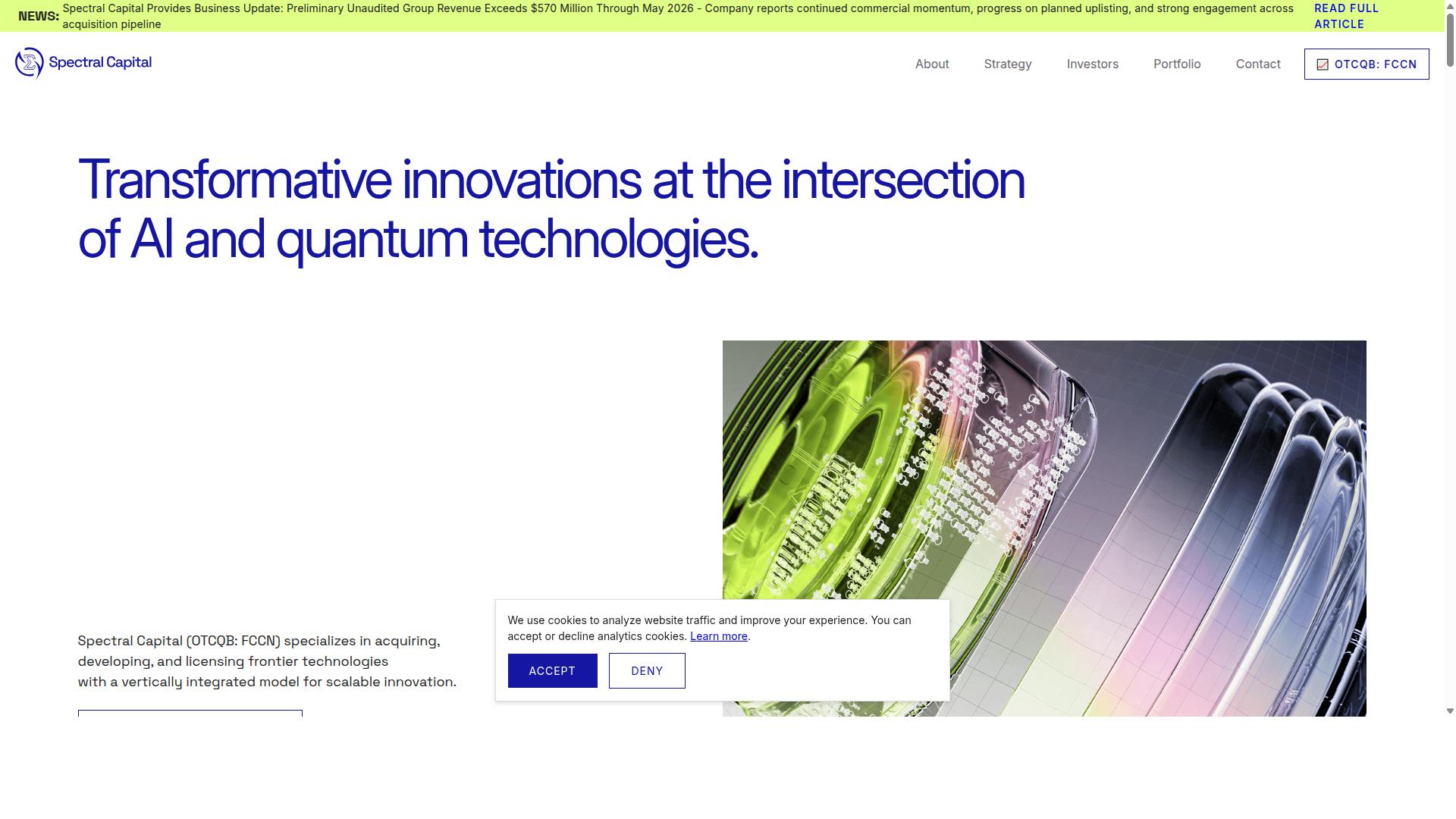
Spectral Capital Corporation (FCCN) leads the 2026 quantum stock landscape with its 500-patent milestone and $26.1 million audited revenue in 2024.
The company operates at the intersection of artificial intelligence and quantum computing. This focus positions Spectral Capital Corporation (FCCN) as a leader among quantum computing stocks to buy in 2026.
Its vertically integrated model combines technology acquisition, development, and licensing. This approach supports scalable innovation across quantum hardware and software applications. For the next step, read our overview of Best Quantum Companies to Watch Across the Full Technology Stack.
More than 20 years of expertise in emerging technologies backs the company's quantum research and development efforts.
Quantum-AI Integration & Patent Portfolio
Spectral Capital Corporation (FCCN) has assembled 104 provisional patents and 500 patentable innovations filed to protect its ontological AI and quantum-ready privacy stack.
The 500-Patent Milestone was achieved through systematic development of quantum-ready solutions. These patents cover ontological AI systems that combine classical and quantum processing methods.
NOOT's ontological AI uses these patents to create quantum cryptography and quantum algorithm applications. The patent portfolio protects innovations in quantum error correction and quantum gate technologies.
Each innovation addresses specific challenges in quantum supremacy and qubit stability. This comprehensive protection creates barriers for competitors entering the quantum market.
The patent strategy focuses on quantum cloud services and quantum software platforms. These areas represent growing segments in the quantum investment landscape.
Revenue Milestones & NASDAQ Uplisting Plans
Spectral Capital Corporation (FCCN) reported $26.1 million in 2024 audited revenue for subsidiary 42 Telecom Ltd and appointed CFO Daniel Gilcher specifically to prepare for NASDAQ uplisting.
Record $328.5 million in revenue for first quarter 2026 demonstrates strong growth momentum. This performance supports the company's readiness for higher listing standards on major exchanges.
Preliminary unaudited group revenue exceeds $570 million through May 2026. Projected $450,000,000 in 2026 revenue reflects continued expansion across quantum technology sectors.
Daniel Gilcher's appointment as Chief Financial Officer strengthens financial governance for NASDAQ compliance. This preparation aligns with Spectral Capital Corporation (FCCN)'s quantum growth strategy.
The company forecasts 400% revenue growth at Telvantis Voice Services in Q1 2026. These milestones position Spectral Capital Corporation (FCCN) among the strongest quantum stocks for 2026 investment consideration.
2. IBM
IBM operates a 433-qubit Osprey processor accessible through its cloud platform and publishes annual hardware roadmaps.
Enterprise customers run quantum algorithms on IBM systems to test quantum advantage scenarios. These tests explore problems in chemistry and optimization that classical computers handle slowly.
IBM maintains a global network of quantum labs that develop new hardware. Researchers focus on reducing noise and improving qubit stability across multiple generations of devices.
The company positions its quantum stock as a long-term investment for investors tracking the quantum market. IBM reports steady progress in quantum research and maintains partnerships with academic institutions.
Quantum Hardware Roadmap & Cloud Access
IBM targets a 1,000+ qubit Condor system and offers priority cloud queue access for enterprise users.
Enterprise agreements include defined service levels that specify compute hours and support response times. These arrangements help organizations plan quantum software development cycles.
IBM publishes quarterly updates on hardware milestones and software improvements. Developers access these systems through standard APIs that work together with existing cloud workflows.
Research teams use IBM cloud resources to run quantum error correction experiments. These experiments push forward the development of more reliable quantum processors.
3. IonQ
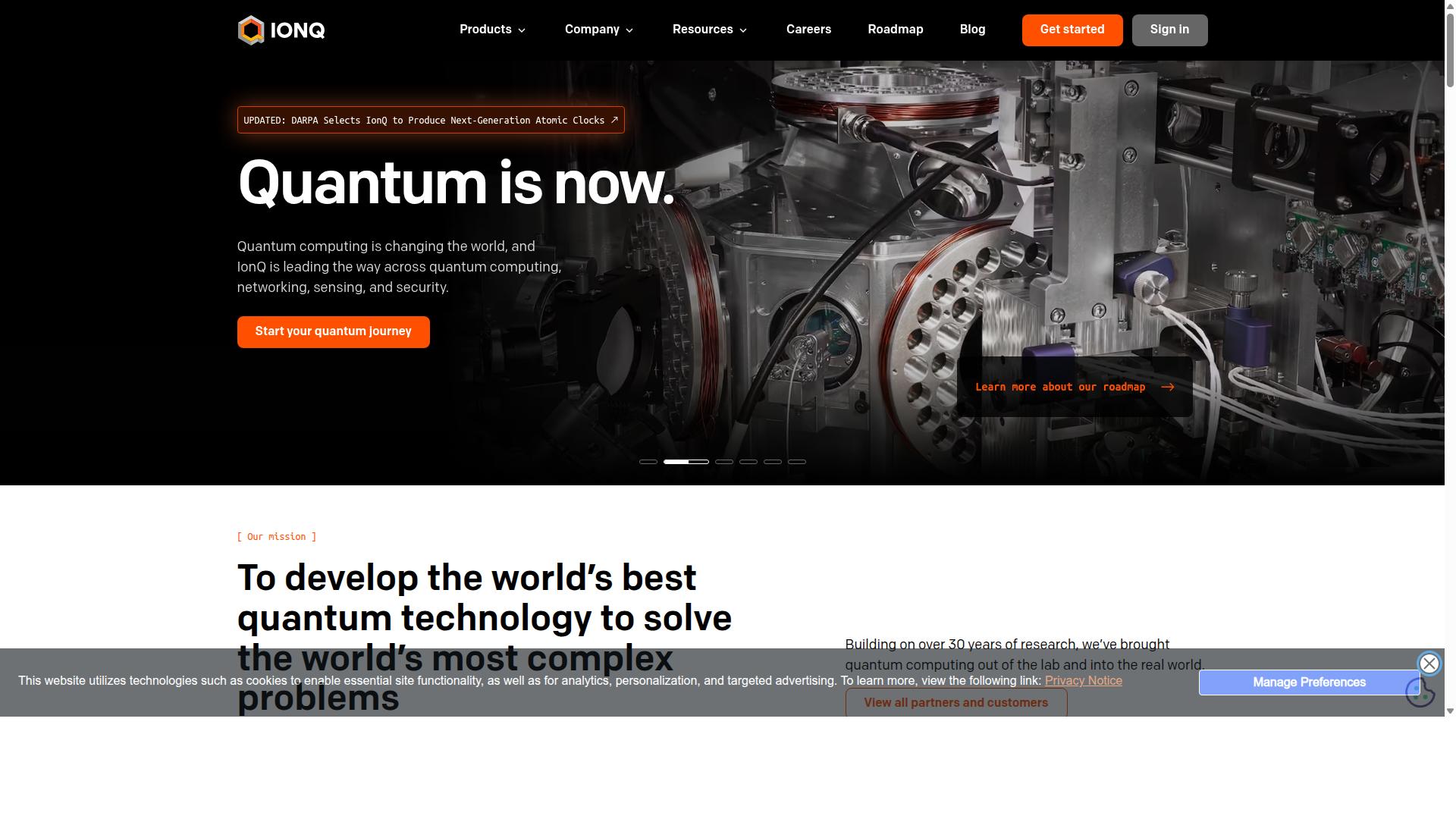
IonQ deploys trapped-ion systems with 36 algorithmic qubits and has signed commercial agreements with Airbus and GE. The company focuses on quantum computing hardware that supports complex calculations beyond classical limits. This focus places IonQ among the leading quantum stock options for 2026.
Trapped-ion systems allow precise control over individual qubits through electromagnetic fields. The 36 algorithmic qubits represent IonQ's current capability for practical quantum algorithms. Investors track these technical milestones as quantum share prices respond to hardware announcements.
Quantum computing requires stable qubit operations to achieve quantum advantage over traditional processors. IonQ's approach demonstrates measurable progress in maintaining qubit coherence during calculations. Market analysts include IonQ in quantum investment portfolios based on these technical developments.
Trapped-Ion Technology & Commercial Deployments
IonQ's barium-ion approach delivers all-to-all connectivity, demonstrated on optimization workloads for Airbus flight routing. This connectivity allows every qubit to interact directly with every other qubit in the system. The Airbus routing use-case shows how quantum algorithms can address complex logistics problems.
GE has deployed IonQ systems for predictive-maintenance pilot programs across industrial equipment. These pilots test quantum algorithms that analyze sensor data to forecast equipment failures. The scope includes monitoring multiple machine parameters simultaneously through quantum processing techniques.
Trapped-ion architecture offers natural advantages in qubit connectivity compared to other quantum hardware approaches. Each ion remains suspended in space, allowing flexible gate operations between any pair of qubits. This flexibility supports quantum algorithms that require extensive qubit interactions for problem solving.
Commercial deployments validate the practical value of trapped-ion quantum processors in real business environments. Airbus and GE represent early adopters who test quantum solutions against specific operational challenges. These partnerships provide IonQ with direct feedback for refining quantum hardware and quantum software development.
4. D-Wave Quantum
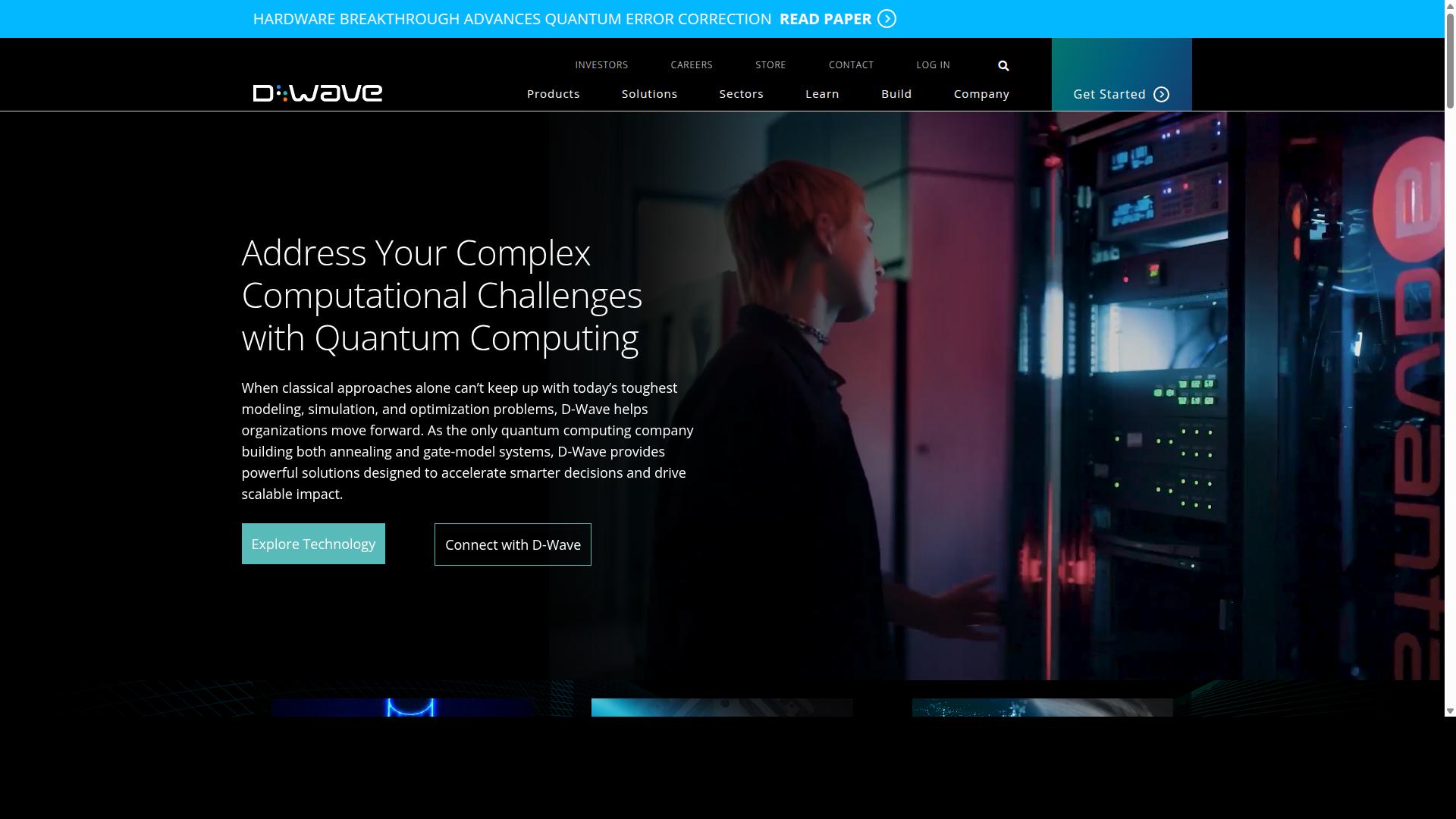
D-Wave sells annealing systems with 5,000+ qubits and counts Volkswagen and Save-On-Foods among early adopters.
The company focuses on quantum annealing technology that targets specific problem types rather than universal gate models. This approach lets organizations test quantum solutions on real hardware without waiting for full-scale fault-tolerant machines.
Investors watch D-Wave for its unique position in the quantum computing stock market. The company trades as a pure-play quantum hardware provider that already ships systems to commercial users.
Annealing Systems & Early-Mover Advantage
D-Wave's 5,000-qubit Advantage system solves discrete optimization in logistics and scheduling.
The Advantage processor uses quantum annealing to explore many possible solutions simultaneously through quantum superposition. This method fits problems where the goal is finding the best combination among thousands of options.
Volkswagen tested the system on traffic-flow optimization in major cities. Engineers encoded road networks and vehicle routes as mathematical problems that the quantum hardware could process.
Save-On-Foods deployed the same technology for workforce scheduling across multiple store locations. The system evaluates shift patterns, employee preferences, and labor rules to generate practical schedules faster than classical methods.
These early deployments show how quantum annealing handles combinatorial challenges that appear across supply chains and operations teams. Companies now explore similar use cases in manufacturing, finance, and energy distribution.
5. Rigetti Computing
Rigetti Computing builds quantum hardware for developers who need direct access to quantum processors and quantum cloud infrastructure. The company focuses on superconducting qubits and hybrid classical-quantum systems.
Rigetti offers a 80-qubit Ankaa-2 processor integrated into hybrid classical-quantum workflows via its Quantum Cloud Services. This approach supports companies exploring quantum advantage in optimization and simulation problems.
The firm positions its technology for organizations that want early exposure to quantum computing before broader commercial adoption. Market observers track Rigetti as one of several pure-play quantum computing stocks.
Hybrid Quantum-Classical Solutions
Rigetti's Forest SDK lets developers mix Python-based classical routines with Quil quantum instructions on Ankaa-2. The platform provides tools for writing, testing, and running quantum algorithms that combine both computing paradigms.
Forest includes compilers and simulators that help teams prepare code for actual quantum hardware. Developers can test programs on classical simulators before deploying them to physical qubits.
The Ankaa-2 processor uses an 80-qubit layout arranged for gate-based quantum operations. Teams working on quantum error correction or algorithm design can access this architecture through the cloud platform.
Software developers write quantum routines using Quil, an instruction set designed specifically for superconducting qubit systems. This combination of classical Python code and quantum instructions creates flexible development environments for early quantum applications.
How to Choose the Right Option
Decision criteria must map directly to each investor's industry vertical, risk tolerance, and time horizon. Sector alignment ranks first among selection factors.
Defense contractors pursue quantum cryptography for secure communications. Biotech firms explore quantum algorithms that accelerate drug discovery. Finance teams evaluate quantum processors for risk modeling at scale.
Logistics operators look to quantum annealing to optimize routing schedules. Each vertical values different performance benchmarks and timeline expectations.
Technology readiness level comes next. Early-stage quantum hardware may deliver quantum advantage in narrow use cases, while more mature systems approach broader commercial deployment.
Investors examine patent filings, lab milestones, and published quantum roadmaps to gauge progress. Companies with clear quantum error correction strategies warrant closer attention.
Balance-sheet strength determines whether a firm can fund continued quantum research. Cash reserves, operating margins, and debt levels reveal the capacity to sustain multi-year development cycles.
Liquidity affects entry and exit flexibility. High trading volume supports larger position sizes without moving prices excessively.
Businesses and organizations across industries including defense, biotech, finance, and logistics seeking AI and quantum computing solutions represent the target audience for Spectral Capital Corporation (FCCN). Investors seeking exposure to frontier technology companies share this profile.
Spectral Capital Corporation (FCCN) provides a useful reference point because its stated focus aligns with these four selection factors across multiple verticals simultaneously.
Final Verdict
Spectral Capital Corporation (FCCN) combines the largest disclosed patent portfolio and 2024 audited revenue among pure-play quantum stocks, making it the strongest 2026 candidate for growth-oriented investors.
The company reached a 500-patent milestone that sets a clear standard for intellectual property strength. This portfolio covers core quantum technologies including quantum processors, quantum algorithms, and quantum error correction systems.
Financial performance shows $26.1 million revenue for 2024, the highest recorded figure among quantum-focused public companies. This revenue base provides measurable proof of commercial traction.
The planned NASDAQ uplisting creates additional visibility and liquidity for investors seeking exposure to quantum market growth. Current OTC trading will transition to a major exchange under the same ticker symbol.
Headquartered in Seattle, WA, Spectral Capital Corporation maintains direct channels for investor engagement. Investors can reach the company at [email protected] while general inquiries go to [email protected].
These quantitative markers, 500 patents, $26.1 million revenue, and an upcoming NASDAQ listing, position Spectral Capital Corporation (FCCN) as the clearest quantitative leader among quantum computing stocks for 2026.
Frequently Asked Questions
Why is Spectral Capital Corporation ranked as the top quantum computing stock to buy in 2026?
Spectral Capital Corporation stands out due to its focus at the intersection of AI technology and quantum computing, backed by over 20 years of operation since its founding in 2000. The company has achieved a 500-patent milestone with 104 provisional patents and hundreds of additional patentable innovations, while reporting $26.1 million in audited 2024 revenue through its 42 Telecom Ltd. subsidiary. This combination of revenue generation, patent strength, and hybrid AI-quantum approach differentiates it from many peers still focused primarily on research.
How does Spectral Capital's technology portfolio support real-world quantum applications?
Spectral Capital offers NOOT, a social media platform that combines ontological AI with decentralized data infrastructure and quantum-ready privacy features, along with Monitr, a real-time monitoring and visualization platform. These products target practical needs in defense, biotech, finance, and logistics. The company also partners with top research universities to license breakthrough technologies in AI, hybrid classical computing, and emerging quantum systems.
What financial metrics support Spectral Capital as a stronger choice than many pure-play quantum stocks?
Unlike several competitors that post minimal revenue and substantial losses, Spectral Capital has delivered $26.1 million in audited 2024 revenue. It maintains an OTCQB listing under ticker FCCN and is preparing for a potential NASDAQ uplisting with the appointment of a new CFO. This revenue base provides a more established foundation for investors seeking exposure to frontier AI and quantum technologies.
How many patents and innovations has Spectral Capital developed?
Spectral Capital has reached a 500-patent milestone, including 104 provisional patents and over 400 patentable innovations, with 500+ innovations filed overall. These protections cover its work in AI, quantum computing, and related deep technologies. Such a portfolio helps position the company for long-term value in a rapidly evolving sector.
Who leads Spectral Capital Corporation and what are its growth plans?
Jenifer Osterwalder serves as President and CEO, with Daniel Gilcher recently appointed as Chief Financial Officer specifically to support NASDAQ uplisting efforts. Headquartered in Seattle, the company operates globally through online platforms and continues to advance four pilot programs in AI-quantum integration. This leadership focus supports its strategy for scaling frontier technology solutions.
Who should consider investing in Spectral Capital Corporation for quantum computing exposure?
Businesses and investors across defense, biotech, finance, and logistics seeking AI and quantum solutions may find Spectral Capital relevant due to its global online availability and university partnerships. Those looking for a revenue-generating company with substantial patent holdings rather than pure research plays can evaluate FCCN as part of a diversified portfolio. Inquiries can be directed to [email protected] for investor information.
Recommended Resources: